Provider credentialing is essential to building a safe, reliable healthcare network. It is also a detailed administrative process involving applications, licenses, education, training, certifications, work history, exclusions, insurance coverage, and other important information.
For healthcare organizations with limited administrative resources, credentialing can become time-consuming. Missing documents, expired credentials, conflicting information, and repeated follow-up can delay provider participation and place additional pressure on staff.
Artificial intelligence may help healthcare organizations make this process faster, more organized, and easier to monitor. However, AI should assist qualified credentialing professionals—not replace them.
Organizing Provider Information
A typical credentialing file may contain information submitted through online forms, scanned documents, emails, databases, and primary sources.
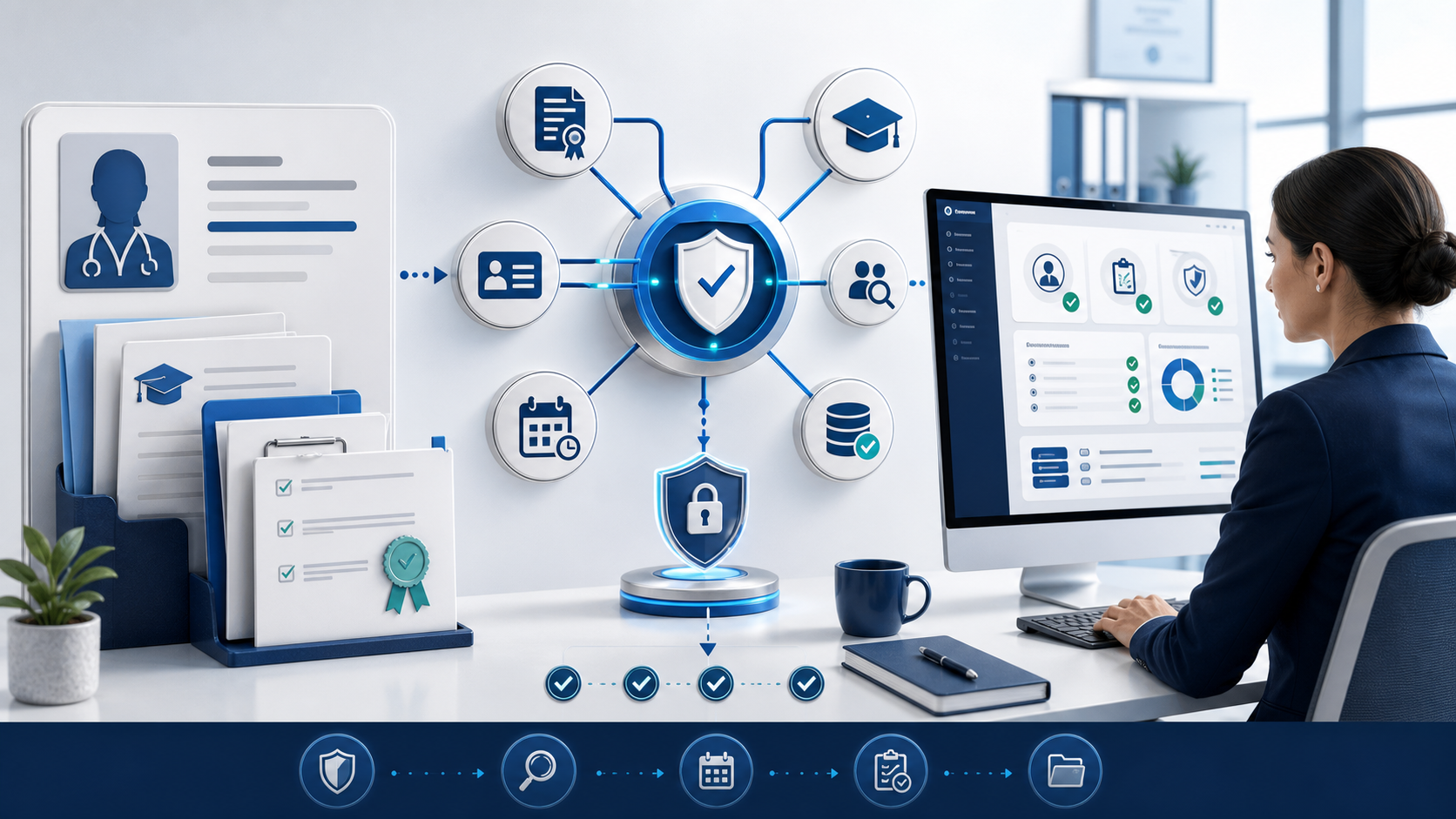
An AI-assisted system could help collect this information and organize it into a consistent provider record. It may identify document types, extract important dates, and place information into the appropriate sections of the credentialing file.
Instead of manually sorting every page, credentialing personnel could begin with an organized record and concentrate on verification, exceptions, and final review.
Finding Missing or Inconsistent Information
Small mistakes can create major delays. A license number may be missing, a date may conflict with another document, or an insurance certificate may have expired.
AI could examine the assembled file and flag concerns such as:
- Missing application sections
- Incomplete work or education history
- Conflicting names, dates, or identification numbers
- Expired licenses, certifications, or insurance
- Documents requiring additional verification
- Unexplained gaps that need human review
These alerts would not prove that information is correct or incorrect. They would simply help credentialing personnel find items that deserve attention.
Supporting Verification Workflows
AI may also help coordinate verification tasks. The system could direct staff to the appropriate authoritative source, record when a check was completed, and preserve the result in an audit trail.
For example, an assisted workflow could help staff manage professional-license verification, education and training confirmation, identity information, certification status, and exclusion screening.
Federal regulations require certain health plans to maintain written credentialing and recredentialing processes. AI may make those processes easier to manage, but it does not remove the organization’s responsibility to follow its approved policies and applicable requirements. See 42 CFR § 422.204.
The HHS Office of Inspector General also maintains the List of Excluded Individuals and Entities. Healthcare organizations need reliable procedures for checking exclusion information and acting on potential matches. An automated system could schedule searches and identify possible matches, while trained personnel complete the necessary verification. Learn about the OIG Exclusions Program.
Monitoring Credentials After Approval
Credentialing is not finished when a provider is approved. Licenses, certifications, insurance policies, and other credentials may expire or change.
An AI-assisted system could monitor important dates and notify staff before a credential expires. It could also organize recredentialing tasks, track requested documents, and escalate overdue items.
This creates the possibility of moving from occasional manual reviews to a more continuous monitoring process. Staff would have better visibility into the status of the network without relying entirely on spreadsheets, calendars, and individual reminders.
Improving Provider Directory Information
Credentialing information may also support provider directories and other operational systems. When provider information is entered separately into several systems, errors and outdated information become more likely.
AI could help compare records and flag differences in names, specialties, locations, contact information, or participation status. Human staff could then review the discrepancy and determine which information is correct.
More consistent information may improve internal reporting, network management, and communication with patients and participating organizations.
Human Decisions Must Remain Central
Provider credentialing affects network participation, patient access, regulatory responsibility, and professional reputation. It should not become an unsupervised automated decision.
AI should not independently approve or deny a provider. It should not treat an internet search as primary-source verification, overlook conflicting evidence, or make assumptions when important information is missing.
Qualified personnel and properly authorized committees must remain responsible for reviewing the complete file, evaluating exceptions, following organizational policy, and making the final decision.
Privacy and security are equally important. Credentialing systems may contain sensitive personal and professional information. Access controls, secure storage, documented procedures, staff training, and careful vendor evaluation should be part of any implementation.
AI tools should also be tested for accuracy and monitored for unreliable or inconsistent results. The National Institute of Standards and Technology’s voluntary AI Risk Management Framework provides useful guidance for managing trustworthiness and risk when organizations evaluate AI-enabled systems. Review the NIST AI Risk Management Framework.
A Valuable Opportunity for Rural Healthcare
Rural healthcare organizations often manage broad responsibilities with smaller administrative teams. They may also coordinate providers across multiple facilities, specialties, and geographic locations.
AI-assisted credentialing could help these organizations:
- Reduce repetitive administrative work
- Identify missing information sooner
- Improve monitoring and follow-up
- Create clearer documentation and audit trails
- Support consistent credentialing procedures
- Give experienced staff more time for complex decisions
The greatest opportunity is not removing people from credentialing. It is giving those people better tools.
Preparing for the Future
Healthcare organizations interested in AI-assisted provider credentialing should begin with a careful review of their existing process. They should identify delays, repeated manual tasks, inconsistent data, and areas where better monitoring would provide the greatest benefit.
A gradual approach is often best. Document organization, expiration alerts, workflow tracking, and exception detection can be introduced while existing approval controls remain in place.
Delta Rural Healthcare Services can help healthcare organizations examine their administrative needs, improve credentialing workflows, and evaluate technology that supports efficient, responsible provider network development.
AI has the potential to make credentialing faster and more manageable. Its real value will come from combining capable technology with experienced people, reliable sources, clear policies, and responsible human judgment.